

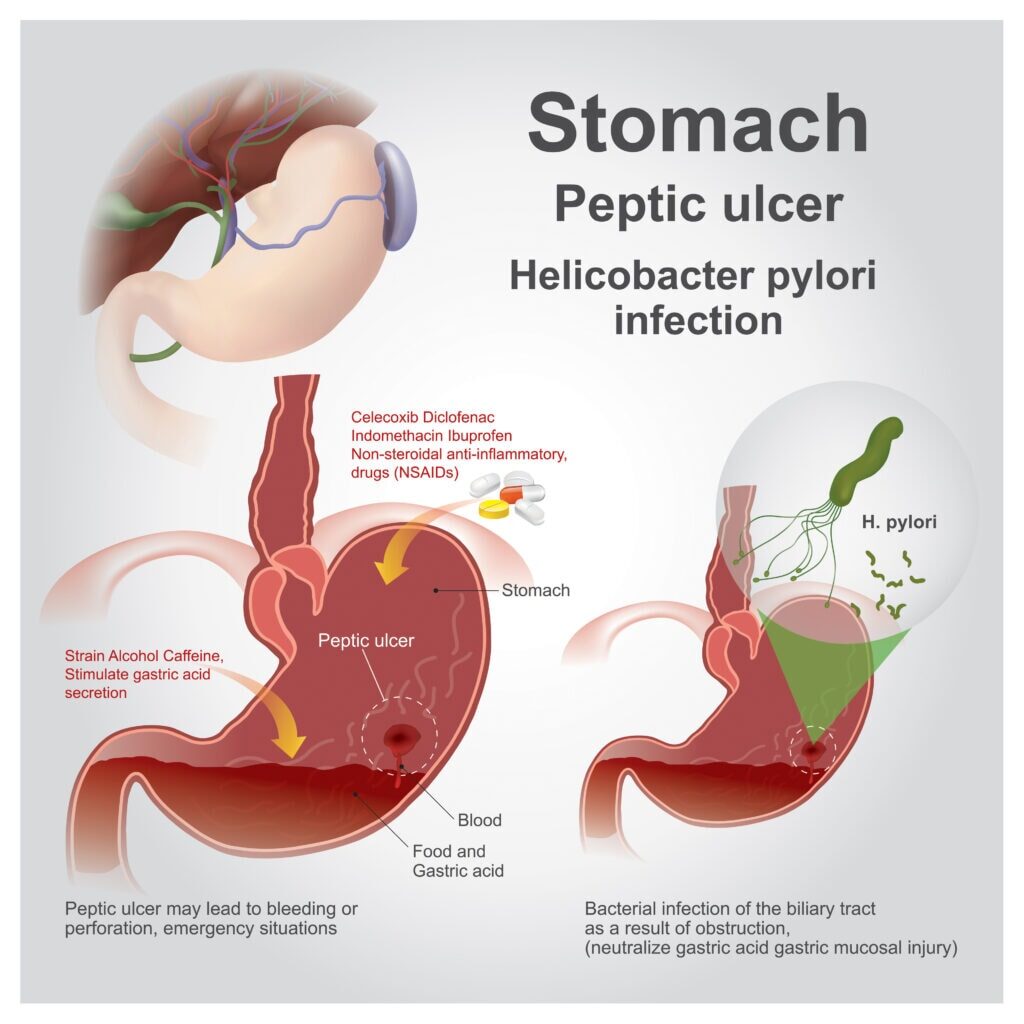
Helicobacter Pylori (H. Pylori) is a type of bacteria. They can enter your body and live in your digestive tract for your entire life. This often happens during childhood and is often present in half of the population.
After some time, the bacteria can cause peptic ulcers (sores) in the lining of your stomach or the upper part of your small intestine. For some people this can lead to stomach cancer.
What causes H. Pylori infection?
The exact cause of H. Pylori is unknown. Some believe that it can be passed via saliva, vomit or faecal matter or through contaminated water or food.
Although the risk of having the infection is increased you have/are:
Living in crowded conditions.You have a greater risk of H. pylori infection if you live in a home with many other people.
Living without a reliable supply of clean water.Having a reliable supply of clean, running water helps reduce the risk of H. pylori.
Living in a developing country.People living in developing countries, where crowded and unsanitary living conditions may be more common, have a higher risk of H. pylori infection.
Living with someone who has an H. pylori infection.If someone you live with has H. pylori infection, you're more likely to also have H. pylori infection.

Symptoms
Many people can have H. Pylori and not have any symptoms, until perhaps they develop the symptoms of a peptic ulcer, at which your GP will often test you for it.
Other symptoms of H. Pylori include:
- An ache or burning pain in your abdomen
- Abdominal pain that's worse when your stomach is empty
- Nausea
- Loss of appetite
- Frequent burping
- Bloating
- Unintentional weight loss
When should I get tested?
If you notice any persistent signs and symptoms that worry you, you should seek immediate medical help:
- Severe or persistent abdominal pain
- Difficulty swallowing
- Bloody or black tarry stools
- Bloody or black vomit or vomit that looks like coffee grounds
When left untreated, with H. pylori infection can lead to:
Peptic ulcers. pylori can damage the protective lining of your stomach and small intestine. This can allow stomach acid to create an open sore (ulcer). About 10% of people with H. pylori will develop an ulcer.
Inflammation of the stomach lining. pylori infection can irritate your stomach, causing inflammation (gastritis).
Stomach cancer. pylori infection is a strong risk factor for certain types of stomach cancer.
Although testing for H. pylori when you are not experiencing symptoms is controversial.
The most common way to test for H. Pylori infection is via a stool test. Your GP can do this, or it can be done as part of a functional stool test.
What to expect from your GP
Often your GP will treat H. Pylori with two different antibiotics at once.
They may also recommend taking acid blocking medication to reduce the production of stomach acid, allowing the stomach lining time to heal.
Following this, your GP may ask you to come back for testing four weeks after your treatment to assess its effectiveness. Further antibiotics may be necessary if the treatment was unsuccessful.
Problems may arise if a person develops a resistance to the antibiotics used. There is also the risk of re-infection.

Alternative approaches
It is believed that many people with H. Pylori infection often have low stomach acid production.
Stomach acid is necessary for many things including providing an inhospitable, acidic environment for bacteria and other pathogens. When stomach acid is low or suppressed, it provides the perfect conditions for many of the ‘bad’ bugs to grow in number.
Probiotics may be useful in the eradication of H. Pylori infection. Probiotics are useful in re-establishing a favourable community of bacteria during and after antibiotics.
Plants and spices have been used since ancient times and their uses have been passed down from generation to generation.
Herbs have also shown some anti-H. Pylori effects:
Turmeric (particularly curcumin) has shown to have an antibacterial effect against H. Pylori
Liquorice is anti-inflammatory and has been seen to have eradication effects against the infection
The organosulphur content of garlic (which gives it its smell and flavour) contributed to its beneficial effect
Broccoli (particularly sprouts) is thought to have antibacterial and antiviral effects.
Green Tea is thought to reduce the growth of H. Pylori
Honey & Propolis are believed to have antibacterial effects against H. Pylori
There has been some promising research in the use of phototherapy in reducing the H. Pylori bacteria.
*Although it is important to note that before using any products/supplements, you should work alongside a qualified and registered practitioner.
I can help you
If you are experiencing any of the symptoms described in this article and they are impacting the quality of your day-to-day activities, it is very important to identify the ROOT CAUSE and address it accordingly. Book a FREE 15 minute chat with me, a qualified and registered practitioner, and I will guide you through the testing process and your personalised treatment.